
Excellence in Strategic Management Teams
Thomas E. Ambler
Senior Consultant, CSSP, Inc.

You are an intelligent leader. Very likely, then, you are pursuing Strategic Management because of its huge payoff. What about teamwork, do you believe it makes a big difference? If your answer is a resounding "Yes," read on. If not, read on anyway, so it becomes a resounding "Yes."
"Teams" are as old as the hills and as varied as the reasons for forming them. In the organizational world the terms "team" and "teamwork" are used so frequently and so loosely that teams that aren't teams are called teams (see what I mean?). Despite this lack of precision, teams/teamwork have become recognized as key elements in the equation for success within most organizations. The concept of formal teams has evolved from narrowly defined, shop floor, self-directed teams to formal teams at senior executive levels. Paralleling this evolution has been codification of best practices covering the structure and behaviors of effective teams.
Much of this codification is the work of three leaders whose books are listed in the bibliography. The first is Jon R. Katzenbach, a long-time senior partner of McKinsey & Co. and currently running his own consulting firm specializing on teams. The second is John C. Maxwell, the prolific guru on leadership and teams. The third is Patrick Lencioni, president of The Table Group and author of several books on management topics, including teams.
This article identifies best team practices for single strategic business units and explores how team structures, behaviors and methodology impact the success of strategic management. It marries the insights on teams from the authors above with the insights on strategic management and teams gleaned from the experience of CSSP consultants.
Team Structure Best Practices
The Katzenbach book, The Discipline of Teams,1 discusses the pros and cons of three different team structures:
- A broad and all-inclusive category called an "Effective Work Group",
- Single-Leader Team Discipline
- Real Team Discipline
Understanding of these distinctions requires that we study the characteristics of each as summarized in Table 1.
Table 1-Categories and Characteristics of Work Group Structures
| Effective Work Group: That Interacts Well |
Single-Leader Discipline: A Performance Unit |
Real Team Discipline: A Performance Unit |
|
| Charter | Clearly understood charter or purpose (not necessarily related to enterprise performance) | Strong performance charter and purpose comprised mostly of individual contributions | Compelling performance challenge comprised of many collective work products |
| Leader | Hierarchical leader promotes open communication and coordination-though always within predictable meeting agenda | Focused, single leader applies relevant experience and know-how to create performance focus | Leadership role shifted/shared among members to reflect and exploit performance potential |
| Goals | Individual goals seldom add up to clear performance purpose for the group. The goals are not outcome-based | Individual outcome-based goals and individual work products that add up to the performance purpose | Outcome-based goals include both individual and collective work products (the latter predominates) |
| Roles | Clear roles in areas of responsibility remain constant throughout the group effort, seldom differentiated by individual vs. collective work product needs | Stable roles and contributions reflect talents and skills of members | Shifting roles and contributions to match varying performance tasks, as well as exploiting and developing member skills/talents |
| Accountability | Accountability is understood, but consequence management principles of enforcement seldom prevail | Individual accountability and enforced primarily by leader; consequence management usually prevails | Both individual and mutual accountability, largely peer- and self-enforced. |
Katzenbach dismisses the Effective Work Group approach and argues strongly that every leader should develop the capability to utilize both the Single-Leader and Team Disciplines in the right situations. As evident from the table above, the Single-Leader Discipline is the appropriate choice when the outcome will result from the sum of the separate, individual contributions of group members who can be directed by a single leader. This choice is fast, efficient, and comfortable, since most organizational units have followed the Single-Leader model for decades.
In contrast, the essence of the Team Discipline is captured by the following definition:
"a small number of people with complementary skills who are
committed to a common purpose, performance goals, and approach
for which they hold themselves mutually accountable."
The following paragraphs expand on Table 1 as to how the Team Discipline differs from the Single-Leader Discipline.
- "In the Team Discipline, decisions are made by the appropriate people whose skills and experience best qualify them to decide." These decisions fall into two categories, content decisions and process decisions. When the process used is somewhat sophisticated and specialized (e.g., strategic planning), a process leader will often facilitate the process and make most of the process decisions.
- "The goals in the Team Discipline are set and affirmed individually and collectively by the group members once they have explored the implications, wrestled with the trade-offs, and developed a shared understanding and mutual sense of commitment. This process differs from the characteristic, one-on-one negotiation between each member and the leader in the Single-Leader Discipline. Moreover, in the Team Discipline the group clearly differentiates between individual goals and collective goals." Investing the time to establish these shared goals heightens commitment and motivation within the team, resulting in time savings later and higher quality of the shared work products.
- "In the Team Discipline, the pace and working approach are set by the group, making the approach a matter of shared commitment. The team chooses the best way to distribute and integrate work, manage logistics and administration, and establish and enforce norms for each other."
- "In the Team Discipline, the group rigorously and consistently evaluates its own results as a team. The team is its own toughest critic. Furthermore, when teams evaluate progress, the dialogue is open, nonhierarchical, and more focused on performance progress and the entire effort of the group than on individual performance."
- "Members of groups using the Team Discipline hold themselves individually and mutually accountable. It is very difficult (if not impossible) for any one member to fail - only the team can succeed or fail. In marked contrast, the Single-Leader Discipline almost exclusively emphasizes individual accountability and development. Indeed, mutual accountability for shared purpose and goals may be the hallmark of the Team Discipline."
Given the substantial opportunity for collective work, the Team Discipline will produce better outcomes than the Single-Leader Discipline, but will typically take longer. Work products, whether individual or collective, should not be confused with decisions.
Katzenbach cites a focus group example, in which a market researcher collaborates with a product designer and a sales representative to design, set up, conduct, and debrief a focus group. "The skills, effort, and talent of all three combine to produce the focus group and what is to be learned from it-their collective work product. The different, but complementary perspectives of the three people working together result in a better set of focus group questions and interactions, as well as a richer interpretation of the response. If only one of these three people conducts the focus group, or even if each of them conducts a separate focus group, the value of their merging perspectives would be largely lost." Here is a classic case of trading-off loss of efficiency for greater effectiveness.
This trade-off leads us to the obvious question, "So, which discipline should we use in our context of Strategic Management?" The answer is both, but let's explore why. First, however, we need to clarify what we mean by the term "Strategic Management."
Strategic Management
As illustrated by Figure 1, Strategic Management is an iterative, overarching, organization-wide, management process. It aligns current decision-making, planning and execution with the organization's longer-term strategy, while simultaneously feeding new learning from up and down the organization into the next cycle of strategy reformulation. It includes a multiple step planning process and a continuing management phase, both of which involve groups of people ideally utilizing either the Single-Leader or Team Disciplines.
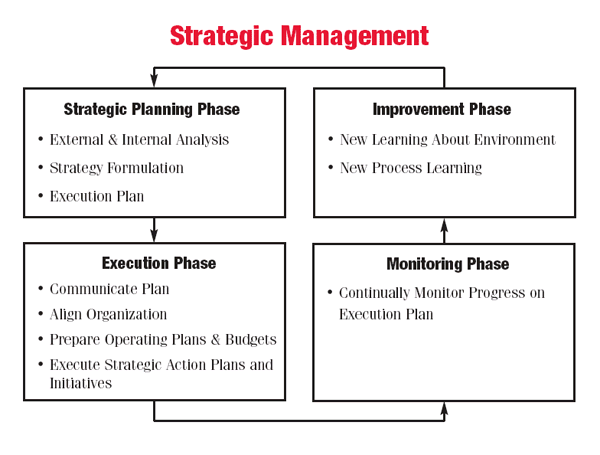
Robust strategic planning processes like Simplified Strategic Planning (SSP) 4 will involve Strategic Planning Teams comprised of the organization's senior management plus a Process Leader. This Process Leader has special expertise in strategic concepts and the use of the process.
The execution phase will require Action Plans developed and accomplished by a multi-disciplinary group led by an Action Plan Leader and will typically involve activities that cut across organizational lines. Although both disciplines will be used for guiding team activity, the Team Discipline will predominate due to the value of the mutual charter, goals and accountability (see Table 1).
The experience of CSSP with teams, captured formally in its book, Simplified Strategic Planning 4 (particularly Chapter 2) and informally, leads to the recommendations in Table 2 below.Table 2-Recommended Team Structure and Discipline for Key Elements of Strategic Management
| Strategic Planning (SP) Phase | Team | Leader | Recommended Discipline |
|
SP Team | Process Leader | Team |
|
Not normally a team | Worksheet Leader | Single-Leader |
|
SP Team | Process Leader | Team |
|
SP Team | Process Leader | Team |
|
SP Team | Process Leader | Team |
|
SP Team | Process Leader | Team |
|
AP Team | AP Team Leader | Team |
|
SP Team | Process Leader | Team |
| Execution Phase | |||
|
AP Team | AP Team Leader | Team for the overall Action Plan Team activity and normally Single-Leader for individual steps (Team, if steps involve multiple people and/or cross departmental lines) |
|
Individual Managers | CEO | Single-Leader |
|
SP Team | CEO | Team |
|
Individuals | (CEO) | Single-Leader |
|
SP Team | CEO | Single-Leader and/or Team |
|
Entire management team | (CEO) | Single-Leader |
Clearly, the success of Strategic Management is tightly linked to the proper mix of Team and Single-Leader Disciplines and Structure.
Team Behaviors
To explore the significant impact of team behaviors, we will focus primarily on the Best and Worst Practices of Teamwork offered by Lencioni and Maxwell. However, before going there, consider Katzenbach and Smith's list of "Thou Shalt Not's" for Team Leaders. (CSSP consultants can say "yes!" to this list based on the misbehaviors of many Strategic Planning teams they have encountered.)
If you are leading a team process and you want to promote mutual accountability, Thou Shalt Not:
- Perpetuate inflexible roles
- Allow share of voice to become a function of hierarchy
- Assign work based on job title and level
- Create special immunities-no one immune from real work
- Look to the leader to make all key decisions
- Allow strong personalities to dominate
- Permit shy members to hang back
- Fail to discipline disruptive or non-contributing members
Avoiding these negative practices highlights why it is crucial to have a strong Process Leader as part of your strategic planning team. Note also that several "Thou Shalt Not's" disappear when the CSSP practice of insisting that all team members "check their egos at the door" is adopted.
The entire Strategic Management process from beginning to end suffers when any of the following five dysfunctions Lencioni cites in his book, The Five Dysfunctions of a Team,2 persists within your Strategic Planning Team.
- The absence of trust (lack of openness and honesty about mistakes and weaknesses)
- The fear of conflict (largely due to lack of trust, this is the inability to engage in unfiltered and passionate debate of ideas)
- The lack of commitment (without airing opinions team members rarely buy in and truly commit to decisions)
- The avoidance of accountability (lack of commitment to a clear team plan of action leads to hesitancy to call peers on actions and behaviors counter-productive to the good of the team)
- The inattention to results (absence of concern for the collective results of the team; individual agendas and performance take precedence over team results)
|
Teams with these dysfunctions inevitably fall far short of optimal results. They simply go through the motions in planning. They make poor decisions based on poor input and unwillingness to "hash things out." "Silo" walls thicken and harden, sometimes even to the extent of reducing transformational, organization-wide action plans to feeble, trivial single-silo action plans.
For a process like strategic planning that is predicated on free, unguarded sharing and the synthesis of knowledge, ideas, opinions, skills, passions and relationships, any one of these dysfunctions can spell doom. That is the bad news. The good news is that the strategic planning process itself has the ability to build the team and whittle away at these dysfunctions. Some improvement will happen automatically. Dramatic improvement can occur through the joint efforts of a strong, but sensitive, process leader and a strong, yet humble, CEO willing to model and encourage desired team behaviors. These behaviors are the positive version of the 5 dysfunctions:
- Trust of teammates
- Readiness to engage in open sharing of ideas without fear of conflict that may arise
- Commitment to team decisions and plans of action
- Willingness to adopt personal and mutual accountability
- Relentless focus on the result the team seeks
|
- The law of significance - one is too small a number to achieve greatness
- The law of the big picture - the goal is more important than the role
- The law of niche - all players have a place where they add the most value
- The law of Mount Everest - as the challenge escalates, the need for teamwork elevates
- The law of the chain - the strength of the team is impacted by its weakest link
- The law of the catalyst - winning teams have players who make things happen
- The law of the compass - vision gives team members direction and confidence
- The law of the bad apple - rotten attitudes ruin a team
- The law of countability - teammates must be able to count on each other when it counts
- The law of the price tag - the team fails to reach its potential when it fails to pay the necessary price
- The law of the scoreboard - the team can make adjustments when it knows where it stands
- The law of the bench - great teams have great depth
- The law of identity - shared values define the team
- The law of communication - interaction fuels action
- The law of the edge - the difference between two equally talented teams is leadership
- The law of high morale - when you're winning, nothing hurts
- The law of dividends - investing in the team compounds over time
|
Conclusion
Strategic Management yields great rewards when approached and conducted properly. Many factors contribute to this strategic success. As we have determined, one of the huge payoff factors is how well an organization "does teams." In contrast to other major factors such as external environmental forces over which an organization has little control, Team Structure and Behavior can become, over time, almost entirely within the control of the leadership of an organization. In addition, a body of "Best Practices" now exists to elevate significantly the "art" of team management.
So, you chose to read on beyond the opening paragraph. Hopefully, you now see the potential for teams in an expanded way. The crucial question remains, "What will be your response?" Will you revise the structure of your teams? Will you adopt some of the best practices? Will you read the books cited? What action will you take?
- Jon R. Katzenbach and Douglas K. Smith, The Discipline of Teams: A Mindbook-Workbook for Delivering Small Group Performance, (New York, NY; John Wiley & Sons, Inc., 2001)
- Patrick Lencioni, The Five Dysfunctions of a Team: A Leadership Fable, (San Francisco, CA: Jossey-Bass, 2002)
- John C. Maxwell, The 17 Indisputable Laws of Teamwork, (Nashville, TN: Thomas Nelson, Inc., 2001)
- Robert W. Bradford and J. Peter Duncan with Brian Tarcy, Simplified Strategic Planning: A No-Nonsense Guide For Busy People Who Want Results Fast, (Worcester, MA: Chandler House Press, 2000)
Tom Ambler is a Senior Consultant with Center for Simplified Strategic Planning, Inc.
He can be reached via e-mail at

